
NORMAN J CLEMENT RPH., DDS, NORMAN L. CLEMENT PHARM-TECH, MALACHI F. MACKANDAL PHARMD, BELINDA BROWN-PARKER, IN THE SPIRIT OF JOSEPH SOLVO ESQ., INC.T. SPIRIT OF REV. IN THE SPIRIT OF WALTER R. CLEMENT BS., MS, MBA. HARVEY JENKINS MD, PH.D., IN THE SPIRIT OF C.T. VIVIAN, JELANI ZIMBABWE CLEMENT, BS., MBA., IN THE SPIRIT OF THE HON. PATRICE LUMUMBA, IN THE SPIRIT OF ERLIN CLEMENT SR., EVELYN J. CLEMENT, WALTER F. WRENN III., MD., JULIE KILLINGSWORTH, RENEE BLARE, RPH, DR. TERENCE SASAKI, MD LESLY POMPY MD., CHRISTOPHER RUSSO, MD., NANCY SEEFELDT, WILLIE GUINYARD BS., JOSEPH WEBSTER MD., MBA, BEVERLY C. PRINCE MD., FACS., NEIL ARNAND, MD., RICHARD KAUL, MD., IN THE SPIRIT OF LEROY BAYLOR, JAY K. JOSHI MD., MBA, AISHA GARDNER, ADRIENNE EDMUNDSON, ESTER HYATT PH.D., WALTER L. SMITH BS., IN THE SPIRIT OF BRAHM FISHER ESQ., MICHELE ALEXANDER MD., CUDJOE WILDING BS, MARTIN NJOKU, BS., RPH., IN THE SPIRIT OF DEBRA LYNN SHEPHERD, BERES E. MUSCHETT, STRATEGIC ADVISORS
THE GREAT SACHEM LUDOVICO WAR AND THE WOLF SHE FEEDS
In an age where technology permeates every aspect of our lives, the promise of predictive artificial intelligence (AI) has captured the imagination of policymakers, law enforcement, and healthcare professionals.
AI is hailed as the next frontier in solving complex problems, from self-driving cars to predictive analytics. But when it comes to the creation of America’s opioid epidemic, a conflated crisis that claims more than 81,000 lives a year, AI has become a dangerous gamble, and the stakes couldn’t be higher.

The U.S. Department of Justice (DOJ), led by figures like Nicole Argentieri, relies heavily on AI-driven solutions to fight the epidemic. It is wielding complex predictive data systems inspired initially by Wall Street risk management models.
The hope is that these systems will identify and disrupt illegal distribution networks, predict where crises will occur, and lead to “maximum harm reduction.”


But beneath the technological polish lies a troubling truth. DOJ’s systems are untested and often ill-suited to handle the nuanced, human-centric reality of a national public health crisis.
The DOJ’s aggressive use of artificial intelligence in combating the opioid epidemic stems from several programs designed to track, predict, and intervene in drug trafficking networks.

These include the DEA Analysis and Response Tracking System (DARTS), the De-confliction and Information Coordination Effort (DICE), and various federal healthcare task forces utilizing AI systems like NBI MEDIC, Qlarant’s Artificial Intelligence, and CMS Predictive Learning Analytics Tracking Outcomes (PLATO).

The underlying principle is simple: Through data fusion, AI systems will flag suspicious patterns of opioid distribution in real-time, enabling law enforcement and public health officials to act swiftly.

These AI programs aim to share de-identified data between public health and law enforcement agencies, turning numbers and AI algorithms into actionable intelligence arrests and persecution of medical doctors, pharmacists, dentists, nurse practitioners, and patients in pain.
Long-Term Capital Management (LTCM) and the Black-Scholes equation
But therein lies the rub because DOJ’s untested systems, inspired by healthcare portfolio insurance models and high-frequency trading AI algorithms, are being repurposed to address a devastating human health crisis.[1]


While AI might be effective at predicting stock market crashes or routing financial investments, it lacks the subtlety and sensitivity required for navigating the opioid crisis, where the consequences of missteps aren’t just monetary. They are human lives.

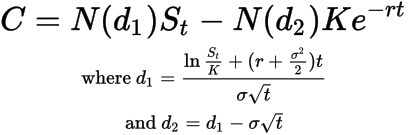
 | = | call option price |
 | = | CDF of the normal distribution |
 | = | spot price of an asset |
 | = | strike price |
 | = | risk-free interest rate |
 | = | time to maturity |
 | = | volatility of the asset |
One of the more troubling aspects of the DOJ’s AI initiative is the influence of Long-Term Capital Management (LTCM)-style risk models. LTCM, a hedge fund that collapsed in 1998, relied on similar AI algorithms to manage complex financial risks, only to find that real-world volatility didn’t behave as the models predicted.

(Infected Diabetic Foot Ulcer)
______________________________________________________________/
- Buffett, Warren E. (2009-02-27). “2008 Letter to the Shareholders of Berkshire Hathaway Inc” (PDF). Retrieved 2024-02-29.none: https://youtu.be/H4X-4e7fPgI
- In Pursuit of the Unknown: 17 Equations That Changed the World. New York: Basic Books. 13 March 2012. ISBN 978-1-84668-531-6.none
- Nahin, Paul J. (2012). “In Pursuit of the Unknown: 17 Equations That Changed the World”. Physics Today. Review. 65 (9): 52–53. Bibcode:2012PhT….65i..52N. doi:10.1063/PT.3.1720. ISSN 0031-9228.none
- ^ a b Stewart, Ian (February 12, 2012). “The mathematical equation that caused the banks to crash”. The Guardian. The Observer. ISSN 0029-7712. Retrieved April 29, 2020.none

“..The model assumes that markets are efficient, that prices follow a lognormal distribution and evolve smoothly without jumps, that volatility is constant over time, and that there are no transaction costs or liquidity issues… However..”


The Black–Scholes model AND THE COST ON HUMAN LIVES
LTCM’s fall was a warning that no matter how sophisticated a system, models based on historical data and assumptions about human behavior are vulnerable to failure.
The 1987 stock market crash, portfolio insurance, Long-Term Capital Management (LTCM), and the Black-Scholes equation are all tied together using complex AI financial models to manage risk and guide trading strategies. Each of these elements played a critical role in understanding how monetary markets behave, especially during times of volatility.



RISK MANAGEMENT IS A FLAWED TOOL DESIGN THAT OFTEN GETS IN THE WAY OF OVERALL HEALTHCARE DELIVERY
Portfolio insurance is a financial strategy that limits stock portfolio losses while maintaining potential gains. It became trendy in the 1980s as a form of risk management, especially among institutional investors like pension funds and mutual funds.
The strategy typically involves dynamic hedging, using derivatives, such as stock index futures and options, to protect against stock market declines.

In the aftermath, the role of portfolio insurance became a key area of debate. While it was intended to mitigate risk, its mechanical selling triggered massive volatility, highlighting the dangers of relying too heavily on automated strategies in volatile markets. As discussed, portfolio insurance involves dynamic hedging strategies to protect portfolios from significant losses.


These strategies often relied on derivatives, particularly options and futures. The mechanics of portfolio insurance were built on theoretical models like the Black-Scholes formula, which provides a mathematical framework for pricing options.
The Black-Scholes model, developed by Fischer Black, Myron Scholes, and Robert Merton in the early 1970s, revolutionized the pricing of options.
It provided a formula for calculating the fair value of options, considering factors such as the stock price, strike price, time to expiration, interest rates, and volatility.
The model assumes that markets are efficient, that prices follow a lognormal distribution and evolve smoothly without jumps, that volatility is constant over time, and that there are no transaction costs or liquidity issues.

The 1987 crash demonstrated the limits of these models, especially in extreme market conditions. Portfolio insurance’s reliance on automated selling created a feedback loop that exacerbated the crash.
The events of 1987 exposed the flaws in using such strategies without accounting for liquidity risks and the impact of crowd behavior (many players simultaneously acting similarly).

the morality police
Now, the DOJ is using AI and data fusion, systems birthed from this very predictive analytics model, in its war against opioids. These programs assume that opioid traffickers and pill mills will behave predictably and that data patterns will lead to reliable insights into illegal activity.


But just as markets swing wildly due to unforeseen events, opioid networks can adapt, evolve, and evade these AI predictive models.
As investors learned from LTCM, algorithms can fail dramatically.
When applied to opioid trafficking, a miscalculation could result in missed opportunities to save lives or, worse, the wrongful prosecution of innocent healthcare providers.

Imagine the fallout if an AI system designed to flag suspicious prescribing patterns inaccurately targets legitimate physicians managing chronic pain patients. The consequences for these individuals, already under intense scrutiny, could be devastating.
One of the cornerstones of these AI systems is their reliance on de-identified data to ensure privacy and confidentiality. The idea is that public health and law enforcement can collaborate without compromising individual privacy by sharing de-identified information.

However, de-identified data comes with its own set of problems. AI systems are only as good as the data they process. When data is stripped of its identifiers, critical context can be lost.

AI algorithms might flag specific patterns as suspicious without considering the broader context, such as socioeconomic factors, chronic disease disorder pain management needs, or geographic healthcare disparities.
De-identified data turns humans into numbers, ignoring the complex realities of the communities suffering from the so-called opioid crisis.


What’s more, the DOJ’s system over-reliance on such data may push public health decisions into the realm of law enforcement, where every flagged prescription could be seen as a criminal act rather than a cry for help.

This blurs the lines between public safety and public health, potentially criminalizing pain patients who are simply trying to manage their conditions.
The opioid crisis is not a problem that can be solved with a one-size-fits-all solution.
It requires the delicate balance of human empathy, medical expertise, and data-driven insights.
Unfortunately, the current rush to deploy AI systems by the DOJ overlooks the complexities of the so-called opioid epidemic.


CREATIVE PROSECUTION = TOUGH AS NAILS AND DUMB AS HELL OF MEDICAL PROTOCOLS AND METHODOLOGIES OF DATA ANALYTICS
While the DOJ proudly touts its $1.3 billion black-market drug busts, the actual costs are hidden in the stories of patients who are denied care, communities that are over-policed, and lives that are shattered by an over-reliance on technology.

Instead of focusing on harm reduction, these AI systems threaten to deepen the divide between public health and law enforcement, making it harder for those who are already vulnerable to get the help they need.
The unintended consequences of using untested AI systems in this context could lead to a public health catastrophe.

The manufactured so-called opioid crisis is a deeply human tragedy. It deserves a response prioritizing individuals’ health and well-being over AI systems’ cold calculations.
While technology can help track and understand drug trafficking patterns, it must be carefully tested, regulated, and balanced by human oversight.
We cannot allow the same reckless reliance on predictive models that led to financial ruin in the past to guide our response to a crisis of this magnitude.

After a month-long trial, a Federal jury acquitted Dr. Lesly Pompy of unlawful prescribing, healthcare fraud, and maintaining a drug-involved premises. Dr. Pompy was represented by Ronald Chapman II, founder of the Chapman Law Group, and George Donnini and Joe Richotte of Butzel Long.
The DOJ’s embrace of AI as a silver bullet is a dangerous miscalculation.
Instead, we must demand transparency, ethical oversight, and, above all, humanity in our approach to solving the opioid epidemic. Because when lives are at stake, we cannot afford to leave our fate in the hands of untested machines.
OR SEND
TO CASH APP:$docnorm
ZELLE 3135103378

ALL WATCHED OVER BY MACHINES OF LOVING GRACE
BE SURE TO DONATE TO THE MARK IBSEN GOFUNDME DEFENSE FUND, WHERE THE SON ALWAYS RISES!!!
FOR NOW, YOU ARE WITHIN
THE NORM
